Program Educational Objectives
| S.No | Program Educational Objectives (PEOs) |
|---|---|
| PEO1 | Professional Excellence: Demonstrate technical competence and innovation in electronics, instrumentation, automation, and control systems, and effectively contribute to industrial, research, and academic sectors. |
| PEO2 | Higher Education and Lifelong Learning: Pursue advanced education, professional development, and lifelong learning in engineering or allied fields to remain current with evolving technologies. |
| PEO3 | Leadership and Teamwork: Exhibit leadership, effective communication, and teamwork in multidisciplinary and multicultural environments while adhering to ethical and professional standards. |
| PEO4 | Societal Contribution: Address real-world engineering problems and contribute meaningfully to society through sustainable and responsible engineering practices that align with national and global needs. |
| PEO5 | Entrepreneurship and Innovation: Engage in entrepreneurship, innovation, and research to develop solutions and products that create value in the fields of electronics, instrumentation, automation, and emerging technologies. |
Program Specific Outcomes
| S.No | Program Specific Outcomes (PSOs) |
|---|---|
| PSO1 | Core Competence in Instrumentation and Control: Apply the principles of electronics, sensors, transducers, signal conditioning, and control systems to design, develop, and maintain instrumentation systems for industrial, medical, and scientific applications. |
| PSO2 | Proficiency in Modern Tools and Technologies: Demonstrate the ability to use modern engineering tools, software, and hardware platforms such as PLCs, SCADA, LabVIEW, MATLAB, and embedded systems to analyze and solve real-time engineering problems. |
| PSO3 | Innovation and System Integration: Design and integrate automation systems using interdisciplinary knowledge in electronics, communication, and computing to enhance productivity, efficiency, and safety in various domains. |
Program Outcomes
| PO No. | Program Outcome (PO) | Mapped WKs |
|---|---|---|
| PO1 | Engineering Knowledge: Apply knowledge of mathematics, natural science, computing, engineering fundamentals and an engineering specialization to develop solutions for complex engineering problems. | WK1 – WK4 |
| PO2 | Problem Analysis: Identify, formulate, review research literature and analyze complex engineering problems reaching substantiated conclusions with consideration for sustainable development. | WK1 – WK4 |
| PO3 | Design/Development of Solutions: Design creative solutions for complex engineering problems and design/develop systems, components, and processes to meet identified needs with consideration for public health, safety, whole-life cost, net zero carbon, culture, society, and environment. | WK5 |
| PO4 | Conduct Investigations of Complex Problems: Conduct investigations of complex engineering problems using research-based knowledge including design of experiments, modelling, analysis, and interpretation of data to provide valid conclusions. | WK8 |
| PO5 | Engineering Tool Usage: Create, select, and apply appropriate techniques, resources, and modern engineering & IT tools, including prediction and modelling, recognizing their limitations to solve complex engineering problems. | WK2, WK6 |
| PO6 | The Engineer and The World: Analyze and evaluate societal and environmental aspects while solving complex engineering problems for their impact on sustainability with reference to economy, health, safety, legal framework, culture, and environment. | WK1, WK5, WK7 |
| PO7 | Ethics: Apply ethical principles and commit to professional ethics, human values, diversity, and inclusion; adhere to national & international laws. | WK9 |
| PO8 | Individual and Collaborative Team Work: Function effectively as an individual, and as a member or leader in diverse/multi-disciplinary teams. | - |
OBE Resources
- Accreditation and outcome based learning
https://www.youtube.com/playlist?list=PLbRMhDVUMngcovB25W1z88L0ccn4NrJ - NBA Accreditation and Teaching-Learning in Engineering
https://www.youtube.com/playlist?list=PLgMDNELGJ1Cab7PZye2xqnnN5DEkqQAQ
- Accreditation and outcome based learning
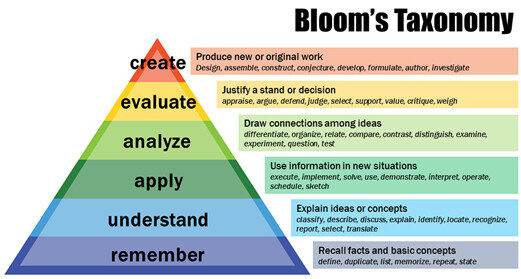
Bloom’s Taxonomy
Bloom’s Taxonomy is a classification of the different objectives and skills that educators set for their students otherwise known as learning objectives. The taxonomy was proposed in 1956 by Benjamin Bloom, an educational psychologist at the University of Chicago. The terminology has been recently updated to include the following six levels of learning. These 6 levels can be used to structure the learning objectives, lessons, and assessments of your course. Bloom’s is hierarchical, meaning that learning at the higher levels is dependent on having attained prerequisite knowledge and skills at lower levels.
1. Remembering: Retrieving, recognizing, and recalling relevant knowledge from long‐term memory.
2. Understanding: Constructing meaning from oral, written, and graphic messages through interpreting, exemplifying, classifying, summarizing, inferring, comparing, and explaining.
3. Applying: Carrying out or using a procedure for executing or implementing.
4. Analyzing: Breaking material into constituent parts and determining how the parts relate to one another and to an overall structure or purpose through differentiating, organizing, and attributing.
5. Evaluating: Making judgments based on criteria and standards through checking and critiquing.
6. Creating: Putting elements together to form a coherent or functional whole; reorganizing elements into a new pattern or structure through generating, planning, or producing.