
Laboratories
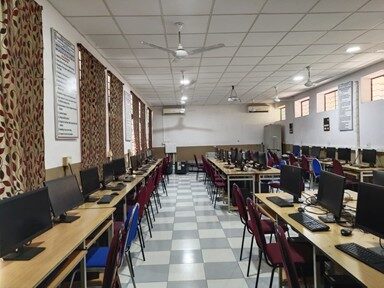
Name of the Lab In-charge: Sri.V. Hari Vamsi
Name of the Staff In-charge: Sri. M. Dinesh Raghava
Intended Participants: UG/PG/Research
Major Softwares Available: Mi Power, PSCAD, MATLAB, PV Sol
The UG Computer Lab caters the needs of B.Tech students exclusively for programming courses and Simulation Studies as per curriculum and also apart from the regular curriculum Students utilize the Laboratory for their project works. The UG Computer Lab is equipped with 45 Desktop systems with a configuration of HP Pro Tower 400 G9 PCI Desktop PC, i5 13th Gen Processor,16GB RAM,1TB HDD and Printer. The Lab is supported with uninterrupted supply for a back up of 30 minutes supported by 12kVA
Name of the Lab Incharge: Dr S.N.V.S.K.Chaitanya
Name of the Staff Incharge: Mr. D. JAGANNADHAM
Intended Participants: UG/PG/Research
- Evaluation of dielectric strength of solid insulators such as polymers, porcelain, and glass.
- Investigation of dielectric performance of composite insulators under high-voltage conditions.
- Measurement and analysis of breakdown strength of transformer oil and other insulating oils at varying temperatures and pressures.
Major Equipment Available:
- 100kV AC Unit
- 140kV HVDC Unit
- 280kV two stage Impulse Unit
- 100 MHz Digital storage oscilloscope
- 100 kV Motorized Test Vessel for Vacuum & Pressure Testing with Corona Cage
- 100 kV Enclosed Sphere Gap for Liquid Insulation Breakdown Test kit
- 10kV Digital Insulation Tester
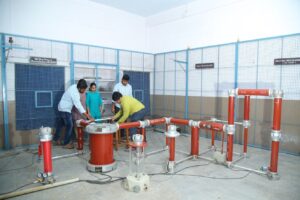
The High Voltage Laboratory, established in 2001 under MODROB in the Department of Electrical Engineering at V R Siddhartha School of Engineering, is a specialized facility designed to support both academic and research needs. Spread over a plinth area of 32 ft × 22 ft, the laboratory is equipped with advanced high-voltage equipment that enables students to study and analyze insulation behaviour, breakdown phenomena, and testing techniques under different high-voltage conditions.
The major equipment in the lab includes a 100 kV AC Unit, 140 kV HVDC Unit, a two-stage Impulse Voltage Generator (280 kV, 280 J), a 100 MHz Digital Storage Oscilloscope, and a 100 kV Motorized Test Vessel for Vacuum & Pressure Testing with Corona Cage. Additionally, it houses a 100 kV Enclosed Sphere Gap for Liquid Insulation Breakdown Testing, a 100 kV Oil Testing Kit, and a 10 kV Digital Insulation Tester.
The laboratory caters to both Undergraduate (UG) and Postgraduate (PG) students by providing hands-on training in high voltage testing, dielectric studies, and insulation performance evaluation, thereby bridging the gap between theory and practical applications in high voltage engineering.
Name of the Lab Incharge: Mrs.S.V.R.Lakshmi Kumari
Name of the Staff Incharge: Mr. D.Jagannadham
Intended Participants: UG/Research
Major Equipment Available:
| S. No | Equipment |
|---|---|
| 1 | Numerical Distance Protection relay (D60) |
| 2 | Numerical Bay Control Unit (F650) |
| 3 | AC Network Analyzer |
| 4 | 360km Long Three Phase EHV Transmission Line Model |
| 5 | Three Phase Fault Simulator and Relay Coordination kit |
| 6 | Air Break Circuit Breaker (ACB) with Thermo Magnetic relay |
| 7 | Microprocessor base OC/EF relay |
| 8 | 5KW programmable DC power supply with solar array simulator |
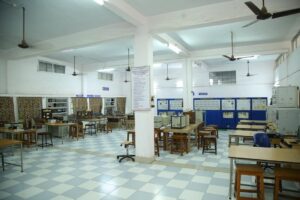
The Power Systems Laboratory is an integral part of the Electrical and Electronics Engineering Department, designed to provide hands-on experience in understanding the transmission, and protection of electrical power. The lab bridges the gap between theoretical classroom learning and practical applications in the field of power engineering, allowing students to explore the operation and behavior of electrical power systems under different conditions. The laboratory is equipped with a wide range of hardware facilities. Hardware setups include transmission line models, transformers, synchronous machines, circuit breakers, and protective relays, which enable students to perform experiments on load flow, fault analysis and voltage regulation. In addition, protective devices are incorporated to study various fault conditions and to understand the coordination of protection schemes in power networks. To complement the hardware experiments are used to analyze and visualize the behavior of large and complex power systems. This combination of experimental and computational resources ensures that students develop a holistic understanding of both theoretical principles and real-world challenges in power system operation and control.
The lab also emphasizes modern trends such as SCADA-based monitoring, helping students stay aligned with industry advancements. Through well-structured experiments, projects, and case studies, learners gain valuable insights into efficient, reliable, and sustainable power system practices. Overall, the Power Systems Laboratory plays a vital role in preparing students to meet the growing demands of the power sector by equipping them with practical skills, analytical abilities, and problem-solving techniques required in the field of electrical energy systems.
Name of the Lab In charge: T. Suneel
Name of the Staff In charge: V.Eswar Ram Subbarao
Intended Participants: UG
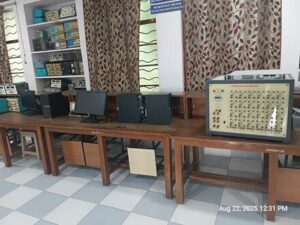
Major Equipment Available: 3-Phase IGBT Based inverter stack, Multi-level inverter, 3 Phase PWM Inverter Drive with Induction Motor, Programmable DC power Supply , Digilent Atlys Spartan 6 FPGA Kits, Basys3 FPGA kits, Texas instruments Development Boards & kits -TMS320, 24 switch inverter module, Buck/Boost Chopper module, Boost Chopper module, Single phase AC Voltage controller, Single phase fully controlled bridge rectifier, 1-Phase H-Bridge inverter
Power Electronics Laboratory
Power electronics deals with the application of solid-state power semiconductor devices for the control and conversion of electric power. Conversion techniques require the switching on and off of power semiconductor devices. Power electronics have already found an important place in modern technology and are now used in great variety of applications with power levels ranging from watts to mega-watt. Such applications include, heat controls, light controls, motor control, power supplies, vehicle propulsion systems and high voltage direct current (HVDC) systems.
Modern power electronics started with the invention of the Silicon Controlled Rectifier (SCR) commonly known as thyristor in 1956. The SCR is a four layer PNPN device with three terminals: Anode, Cathode and Gate. It is operated as a bistable switch operating from non-conducting (OFF) state to conducting (ON) state or vice versa. It is driven to conducting state by applying a gating signal to the gate when the anode is positive with respect to the cathode. Once a thyristor is in a conduction state, the gate has no control and it continues to conduct. It is turned off by reducing the anode current to zero.
At present, a number of power switching semiconductor devices are available; these devices include Power Bipolar Junction Transistor (BJT), Power MOSFET, Insulated Gate Bipolar Transistor (IGBT), Gate turn off thyristor (GTO) etc. All these devices are turned ON or OFF through the control terminal, either base or gate as the case may be. This makes the power control circuitry simpler, since these devices do not require electronics in last two decades, have greatly simplified the necessary control circuitry for power electronics equipment. The developments in the areas of power semiconductor devices, micro electronics and control techniques, in the recent past have made the power electronic equipments more reliable and acceptable for a variety of applications.
For the control of electronic power or power conditioning, the conversion of electric power from one form to another is necessary and the switching characteristics of the power devices permit these conversion. The static power converters perform these functions of power conversion.
The power electronics circuits may be classified into the following types:
- Diode Rectifiers
- AC-DC Converters (Controlled Rectifiers)
- AC-AC Converters (AC Voltage Regulators)
- DC-DC Converters (DC –DC Choppers or Switched Mode Power Supplies)
- DC-AC Converters (Inverters)
- Static Switches
Name of the Lab Incharge: Dr. N. Vamsi Krishna
Name of the Staff Incharge: D.Jaganatham
Intended Participants: UG/PG/Research: UG
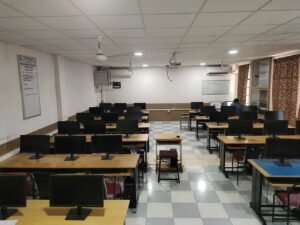
Major Equipment Available: Dell optix 9050 Desktops systems (i5 11th generation), Raspberry Pi boards, Epson LCD projector
The IoT (Internet of Things) lab, an integral part of the curriculum for students in the fifth semester, is a cutting-edge facility designed to enhance practical knowledge and hands-on experience in the world of connected devices. Equipped with a variety of microcontrollers, Raspberry Pi boards, and an array of sensors and actuators, the lab provides students with the tools they need to explore and implement real-world IoT solutions. From interfacing sensors to controlling actuators, students engage in projects that simulate real IoT environments, gaining insights into data collection, communication protocols, and device management. The lab fosters a collaborative learning environment where students can develop innovative applications, preparing them for careers in the rapidly growing field of IoT technology
Name of the Lab Incharge: M.L.N.Vital
Name of the Staff Incharge: B.Suman
Intended Participants: UG/PG/Research: UG
Major Equipment Available: FLUKE Power quality analyzer, CT test set, Tektronix Mixed domain oscilloscope, FLUKE Earth Resistance tester, TMS DSP Boards, PLC’s
Description of the Lab:
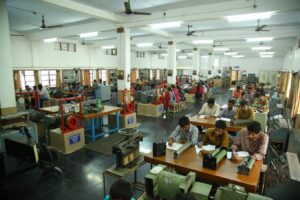
The Electrical Measurements lab is one of the basic laboratories offered by the department of Electrical and Electronics Engineering for the second year B. Tech students. The laboratory meets the theoretical concepts taught in the subject Electrical Measurements and sensors. The total cost of the lab equipment is Rs. 24,75,561/- /-. The total area of the lab is 84.88 sq m. The lab is also equipped with major equipment, such as a FLUKE Power quality analyser, Tektronix Mixed Domain Oscilloscope MDO3034, and a current transformer. These are helpful even for carrying out project work and research activities.
Name of the Lab Incharge: Dr.D.Indira
Name of the Staff Incharge: N. Srinivas
Intended Participants: UG/PG/Research : UG
Major Equipment Available:
- 5HP/230V/1500rpm/DC shunt motor coupled to 3HP/1500rpm/salient pole/rotor excited synchronous altternator .
- Rotary machine setup
- 1 HP / 230 V / PMSM Motor with BDA .
- 1 HP / 200 V / BLDC Motor with BDA .
- Controls for above Two Motor with FPGA & IGBT modules .
- 1 HP /SRM Motor with BDA with IGBT Module ( FPGA will be common for SRM) .
- Alternator set 7.5hp,1500rpm 220v,D.C Motor compound wound
- Dynamotor type 3HP,220V,12002PM D.Cshunt Generator with all accessories as per order. CUT section models of:- I) D.C.Machine Ii)Synchronous Machine
- 0HP/220V/1500RPM / ShuntMotor and 1.5KW/220V/1500RPM/ Series Generator complete with Baseplate and coupling .
- MFG&Supply of Japica make DC Shunt motor coupled to 3 phase Rotating field Type Alternator of 5.5KW DC Shunt Motor 1500RPM . 5 KVA Alternator 380/440V,1500 RPM with Heavy Dutche damper windings in pole Foces Suitable for operation either as Alternator or as Synchronous motor without hunting complete with suitable excitor and Auto synchronous starter exactly as per po. with suitable educational type Brass Terminals brought out on Terminal base.
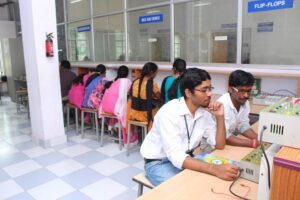
The Electrical Machines Laboratory is well-equipped with a wide range of AC and DC machines, transformers, and testing facilities to provide students with practical knowledge of electrical machine operation and characteristics. The laboratory serves as a vital platform for bridging theoretical concepts with real-time applications in the field of electrical engineering.
Students gain hands-on experience in:
- Testing and performance evaluation of DC machines, induction motors, synchronous machines, and special machines.
- Load tests, efficiency determination, speed control, and regulation studies on various machines.
- Understanding the operational characteristics of single-phase and three-phase transformers.
The lab is designed to enhance technical skills, analytical thinking, and problem-solving abilities. It also supports project work and research activities in advanced areas such as machine design, and electric drives.
With modern measuring instruments and safety provisions, the Electrical Machines Laboratory ensures a comprehensive learning environment for undergraduate and postgraduate students, preparing them for industry as well as higher research.
Name of the Lab In charge: Mrs. Bindu Vadlamudi
Name of the Staff In charge: Mr. B. Suman
Intended Participants: UG
Major Equipment Available: Nil
Electronics Laboratory
The Electronics Laboratory is one of the major and most fundamental laboratories of the department. It serves as a cornerstone in building a strong foundation for students in the fields of Electronics Engineering by bridging theoretical concepts with practical applications.
In this laboratory, students are introduced to basic experiments such as device characteristics and analog circuit design. They gain hands-on exposure to the practical behaviour of semiconductor devices, amplifiers, and analog components, thereby developing an understanding of their intended use in real-world applications. The primary objective of the lab is to enable students to analyse, design, and test electronic circuits while strengthening their fundamental knowledge of components and their characteristics.
The lab is well equipped with modern instruments such as Cathode Ray Oscilloscopes (CROs), Digital Storage Oscilloscopes, Function Generators, Regulated Power Supplies, Digital and Analog Multimeters, and a wide range of electronic devices and ICs. These facilities ensure that students acquire the necessary technical skills to conduct experiments with accuracy and confidence.
Beyond analog electronics, this laboratory also plays a crucial role in imparting knowledge in Digital Electronics. Experiments in this domain include the study and implementation of logic gates, flip-flops, counters, multiplexers, decoders, combinational and sequential logic circuits, as well as digital IC testing and troubleshooting of digital systems. Students also gain practical insight into truth table realization, digital CROs, and circuit design methodologies.
A unique feature of this laboratory is the exposure provided to Printed Circuit Board (PCB) design and development. Students learn the process of translating theoretical circuit designs into practical hardware through PCB layout design, fabrication, soldering, and testing. This not only enhances their circuit realization skills but also prepares them for industry-level design practices in electronics and embedded systems.
A learn-by-doing approach is at the core of this laboratory’s teaching philosophy. Emphasis is placed on hands-on experimentation, systematic circuit analysis, and design validation. This approach not only improves problem-solving and analytical skills but also prepares students for cutting-edge research and industrial applications in electronics field. In summary, the Electronics Laboratory is designed to Provide strong foundational knowledge of semiconductor devices and circuits, develop students’ ability to design, analyse, and troubleshoot analog and digital systems and to train students in PCB design and realization of electronic circuits.
Collabrative Labs
| S.No. | Center / Unit Name | Type of Center / Unit | Stream / Discipline | Center / Unit Level | Program type | Funding Scheme / Support Received | In-charge Name | Area (Sq.m) |
|---|---|---|---|---|---|---|---|---|
| 1 | Siemens ‐ Lift installation lab | Centre of excellence with advanced tools and equipment | Drive selection and wiring for lift installation | UG/PG | Technical | Govt.of AP | Mr.Ravindranath.V | 128.21 |
| 2 | Siemens ‐ Electrical and Energy studies lab | Centre of excellence with advanced tools and equipment | Motor selection, application, speed control of motor, low voltage switchgear control ckt design | UG/PG | Technical | Govt.of AP | Mr.Ravindranath.V | 103.41 |
Class Rooms
The Department of Electronics and Instrumentation Engineering is facilitated with state of the art infrastructure. All the department infrastructure is going to be upgraded from time to time based on the requirements of the students.

Well furnished Classrooms with LCD projectors

Fully equipped laboratories as per curriculum

Department Library

A.C Seminar hall

Internet facility with 100 mbps leased line

Wi-Fi connectivity throughout the department

Waiting rooms for boys and girls
